- Open Banker
- Posts
- It's Time to Think Outside the Box on Stablecoin Yield
It's Time to Think Outside the Box on Stablecoin Yield
Written by Todd Phillips

Open Banker
May 12, 2026

The first-ever Open Banker Salon (June 5, 2026, register here today!) features a certain-to-be electric debate on the GENIUS Act, starring Dan Gorfine, Dan Awrey, Tom Brown, and Dr. Andrew Nigrinis. To whet your appetite, this week we are running two pieces on stablecoins by Salon participants. We founded Open Banker to elevate financial policy debates, but that doesn't mean we aren't above a genteel bout of fisticuffs from time to time. See you there!

Todd Phillips is an assistant professor of law at Georgia State University, where he specializes in bank regulation, derivatives and securities, and administrative law. Prior to entering academia, Todd worked as Director of Financial Regulation at Center for American Progress and as a Senior Attorney at the FDIC.
Open Banker curates and shares policy perspectives in the evolving landscape of financial services for free.
The banking and crypto industries are locked in a battle over whether digital asset intermediaries can pay rewards to stablecoin holders. Despite months of pleas from Congress and the White House that the sides come to an agreement that legislators can enact into legislation, none has appeared — nor appears forthcoming. The reason is simple but eludes current negotiations: The current debate revolves around regulating intermediaries. Refocusing the negotiations on stablecoin issuers may offer a breakthrough. In particular, negotiators should consider reopening the GENIUS Act to allow stablecoin issuers to pay yield directly — in exchange for being regulated like commercial banks.
How We Got Here
The 119th Congress started facing two priorities regarding the regulation of crypto assets. The first was “stablecoin” legislation, which would regulate digital assets that aim to maintain a stable value relevant to a specified asset. Congress tackled this priority last July by enacting the GENIUS Act, which subjects payment stablecoin issuers to regulation by a state or federal banking regulator. The second was “market structure” legislation, which would regulate the issuance and trading of digital assets. Congress is currently considering the CLARITY Act to do just that.
As part of the negotiations to get the GENIUS Act over the finish line, Congress prohibited stablecoin issuers from “pay[ing] the holder of any payment stablecoin any form of interest or yield (whether in cash, tokens, or other consideration) solely in connection with the holding, use, or retention of such payment stablecoin.” This language, seemingly added at the request of the banking industry, appears intended to ensure that stablecoins are used for transactions only. The rationale is that a prohibition on paying yield would prevent issuers from incentivizing token-holders to hold their fiat money in stablecoins, which banks believe would threaten their deposit base. Potential customers would be more likely to choose bank accounts that may pay interest over stablecoins that may not.
The Fight Currently Being Waged
Soon after the proverbial ink had dried on the GENIUS Act, it became clear that although the law prohibited stablecoin issuers from paying yield to stablecoin-holders, it did not prohibit third parties from doing so. As a result, it appears as though stablecoin issuers can earn yield on their stablecoins’ reserve assets, pay a portion of those earnings to intermediaries, and intermediaries can revert some or all of those received funds to token-holders.
Some describe this as Congress’s considered decision, whereas others decry it as a loophole or evasion of the GENIUS Act’s prohibition. Regardless of the framing, digital asset intermediaries currently can offer customers yield in a way that allows stablecoin issuers to compete with banks for cash in a way that issuers alone may not. If intermediaries can pay yield to the holders of stablecoins deposited on their platforms, they can incentivize customers to keep their funds in stablecoins, rather than in deposits. (Put aside for a moment the fact that issuers and primary dealers have bank accounts.)
So the current debate boils down to whether digital asset intermediaries should be able to pay rewards to stablecoin-holders. The Senate Banking Committee’s version of the CLARITY Act provides that “A digital asset service provider may not pay any form of interest or yield (whether in cash, tokens, or other consideration) solely in connection with the holding of a payment stablecoin,” while offering an exemption for “activity-based” rewards. This language appears to have proved sufficient for the crypto industry but not for the banking industry. When new text was proposed to ban intermediaries from paying yield “solely in connection with the holding of a payment stablecoin,” Coinbase opposed it.
This zero-sum framing makes compromise impossible. The banking industry wants to prohibit intermediaries from paying yield in a way that incentivizes customers to hold money in stablecoins. If intermediaries are allowed to pay yield, individuals and non-financial firms will hold funds in stablecoin form, rather than banks. (Or, more realistically, banks will be forced to raise the interest they pay on deposits in order to compete with stablecoin yield rates). Although it is true that stablecoin issuers generally hold reserves in bank deposits and in T-Bills, meaning that reserves backing stablecoins ultimately flow back into the banking system, the funds revert only to the largest banks that provide accounts for issuers and primary dealers rather than the community, regional, and bespoke banks that their customers use. Shifting funds from smaller institutions to those used by multinational firms would decrease the profitability of those smaller banks, leading to their closure.
At the same time, stablecoin issuers and digital asset intermediaries profit when customers hold funds in stablecoins, meaning that they have incentives to keep demand for stablecoins as high as possible. Importantly, these firms already have what they want — the ability to pay yield — and are only incentivized to compromise on legislation to the extent that the overall legislative package will increase profitability by more than any potential loss in stablecoin revenue. Personally, I doubt that market structure legislation can spur digital asset trading to such an extent that increases in trading revenue can make up for lost stablecoin revenue.

Don't miss the conversations shaping the future of finance.
The Financial Technology Association and Semafor are bringing together top policymakers and CEOs for Banking on the Future, a half-day forum on May 20, 2026. Join us for timely, high-stakes discussions that are driving the next era of fintech innovation and the future of finance. Hear from an all-star lineup, including Comptroller Jonathan Gould, HFSC Chairman French Hill, Ranking Member Maxine Waters, Rep. Bryan Steil, House Majority Whip Tom Emmer, Sen. Tina Smith, and leaders from Betterment, Revolut, Wise, and Zip. Request your invitation now.
A Possible Pivot
Given the seeming impossibility of coming to agreement under these conditions, it may prove fruitful to reconsider the fundamental principle underlying the debate in the first place and do the unthinkable: Let stablecoin issuers pay yield directly in exchange for being regulated like commercial banks.
This proposal comes from the recognition that stablecoin issuers, in the absence of regulation, act exactly as banks.1 One need only compare Tether’s various activities over the years to those of depository institutions. Since inception, Tether has issued monetary instruments that serve as claims on its assets, just like bank deposits. And occasionally, Tether has lent these monetary instruments in greater volumes than its reserves, just like fractional reserve banking. The only difference is that Tether’s instruments are token-based (i.e., stablecoins) whereas banks’ instruments are account-based (i.e., bank deposits). But even then, that difference is negligible because banks issued token-based instruments in the form of banknotes prior to their effective abolition in 1865.
Accordingly, it may be worth allowing stablecoin issuers to pay yield directly – just as banks do – in exchange for being regulated like commercial banks. These institutions may not engage in unsafe or unsound practices, are subject to risk- and leverage-based capital requirements, must adhere to consumer payment protection statutes like EFTA, generally must pay deposit insurance assessments, and generally make their parent companies subject to the Bank Holding Company Act. In exchange for these restrictions, banks receive benefits that help to ensure financial stability, including being subject to receivership instead of bankruptcy and access to the Fed’s discount window. Because stablecoin issuers can run just like banks, society would benefit from these institutions having a lender of last resort and a professional receiver ensuring that customers receive funds as quickly as possible.
Importantly, these changes would allow banks and stablecoin issuers to compete on a level playing field, with savings flowing to the institutions that pay the highest rates and payments occurring on the most efficient rails.
No one in the negotiations is calling for these changes, but they might be the breakthrough that is necessary.
The opinions shared in this article are the author’s own and do not reflect the views of any organization they are affiliated with.
[1] Or as Matt Levine observed about the crypto industry writ large, “Often it hit on more or less the same solutions that traditional finance figured out, but with new names and new explanations. You can look at some crypto thing and figure out which traditional finance thing it replicates.”
Open Banker curates and shares policy perspectives in the evolving landscape of financial services for free.
If an idea matters, you’ll find it here. If you find an idea here, it matters.
Interested in contributing to Open Banker? Send us an email at [email protected].
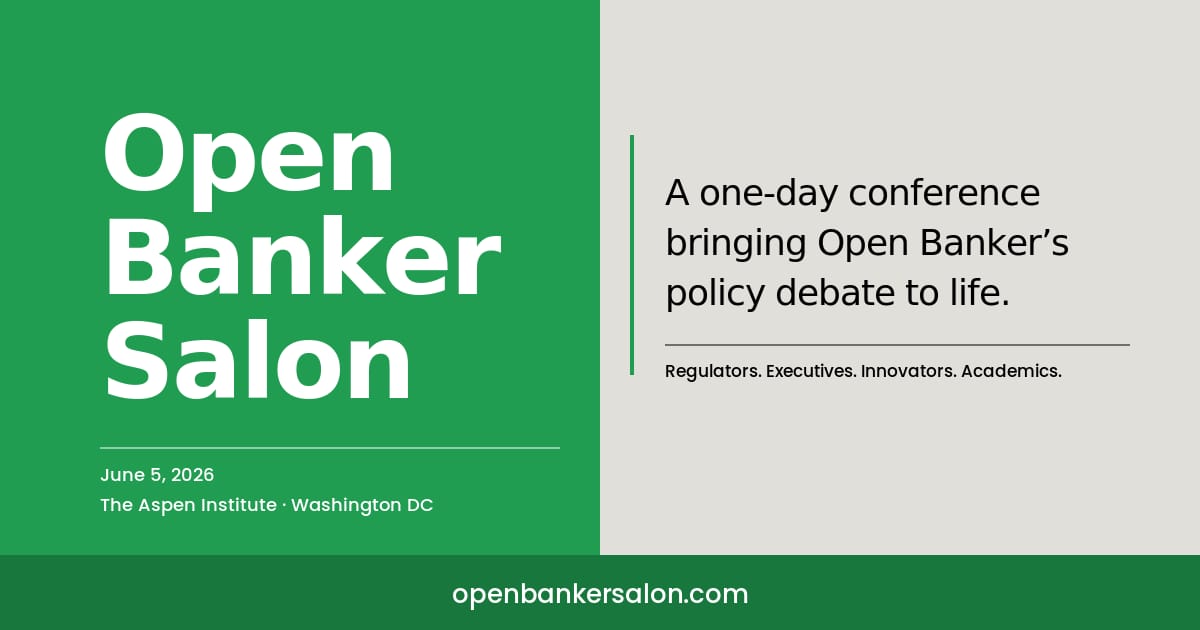
OPEN BANKER SALON - JUNE 5, 2026
We started Open Banker to raise the quality of financial policy debate. Now, we are bringing the newsletter to life with our first ever event: Open Banker Salon. This isn't a typical conference. No 40-minute talking-head panels. No bland keynotes. The Salon is designed for real intellectual engagement with in-depth debate-style discussions.
Location: The Aspen Institute, Washington, DC
Standard pricing ends on May 21. Pay just $795. Register here today!