- Open Banker
- Posts
- Regulators and Fintechs Need to Talk
Regulators and Fintechs Need to Talk
Written by Nat Weber, Ian P. Moloney, and Dan Swislow

Open Banker
March 31, 2026

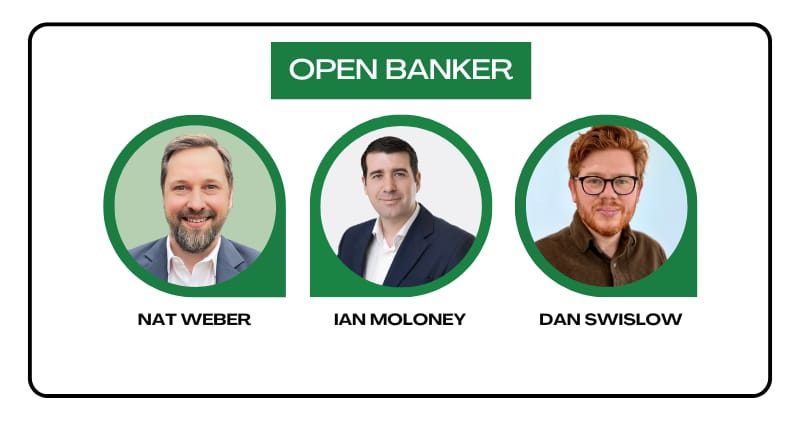
Nat Weber is the Chief Development and Impact Officer of the Americas for the Alliance for Innovative Regulation.
Ian P. Moloney is the Chief Policy Officer at the American Fintech Council.
Dan Swislow is the director of policy and government affairs at Mercury.
Open Banker curates and shares policy perspectives in the evolving landscape of financial services for free.
People are policy, especially in the context of examinations.
Bank examiners at the federal and state levels are tasked with maintaining safety and soundness in an era of rapid change: increasingly complex bank-fintech partnerships, new product delivery channels, third-party dependencies, and emerging technologies like crypto and AI. That is no small task.
The problem isn’t effort, it’s speed. New expertise can be slow to travel from specialist groups and headquarters’ guidance to front-line exam teams. The gap between examiners and the institutions they supervise is costing everyone; the good news is that we can improve it. Thankfully, industry is not the only group thinking about this issue. The House Financial Services Fintech Subcommittee took up this issue earlier this month in a hearing. This recognition shows the will, but additional efforts are needed to show the way.
Building Bridges Between Bank Examiners and Fintechs
Federal and state agencies, and examiners themselves, invest heavily in training and continuing education. A 2023 GAO report noted that agencies have developed programs and provided training to build staff knowledge of advancements in financial technology, while also pointing to opportunities to better assess fintech-related skill needs and evaluate training effectiveness as the space evolves. And there are also great events like the Federal Reserve Bank of Philadelphia’s Annual Fintech Conference that offer opportunities for connection every year.
However, there needs to be more structure to these discussions, especially with regulators on the front lines. This is where assistance from the private sector can help exam teams understand how technology is changing and how it is being deployed across banks and their partner institutions.
Last year, the Alliance for Innovative Regulation (AIR), American Fintech Council, Mercury, and Orrick convened a panel of experienced bank supervisors from each of the federal prudential regulators and a state regulator, moderated by counsel from the fintech Mercury. The session was framed by the humbling reality that the bank-fintech partnerships space continues to evolve and no one has all the answers. We wanted to hear what the world looks like from examiners’ seats — what is working, what isn’t, and where collaboration could help.
What struck us and our audience the most was how valuable and rare this convening was. We left with the understanding that banks, fintechs, and regulators, particularly field office examiners, should explore how to engage more regularly to share information that will ultimately promote safety and soundness across the financial services ecosystem.
Learning #1: Examinations Work Best When the Basics are Easy to Verify
Examinations are fundamentally about understanding risk and validating controls. Examination teams are often coming into a product, partnership, or business line during brief exam windows and need to form a clear picture quickly, including understanding which activities are involved, how things operate, where risks sit, and how oversight and escalation work. When the basics are clear and well-documented, examiners can spend time focused on risk assessment and testing controls that ensure banks operate in a manner consistent with their risk profiles. Trust, but verify.
In innovative areas, “basic information” has a very specific meaning. In particular, we saw strong alignment around the value of a few foundational artifacts:
A clear flow of funds and product walkthrough, in plain language with no marketing gloss;
A responsibility map across the bank and third parties that matches contractual terms to operational reality; and
Evidence the bank can oversee the third party in practice: due diligence, ongoing monitoring, issue management, escalation, and enforcement.
When those elements are crisp, examiners can go deep where they need to — consumer compliance, CRA, BSA/AML, IT, third-party risk management, etc. — without getting stuck reconstructing the fundamentals of how products and business lines work.
Learning #2: Consistency is Hard When Innovation Moves Faster Than Playbooks
The realities of modern supervision are that expertise is distributed, examination teams are multidisciplinary (and lean), and novel activities often span multiple portfolios and geographies. Agencies already have robust mechanisms to train examiners and share learnings, but the pace of innovation creates new business models and use cases faster than shared reference points. The result can produce uneven expectations across teams because institutions, partnerships, and technologies are evolving in real time.
The GAO has similarly observed that the pace and evolving nature of financial technology can exacerbate oversight challenges and raise questions about how regulators sustain the technological expertise needed for effective supervision. But the GAO’s recommendations have not solved the problem of examiners keeping pace with the change of industry. And they likely can’t. Something else is needed.
Learning #3: Public-Private Dialogue Can Strengthen Examination
Supervisors and industry can engage in a structured, non-adversarial setting without compromising independence or confidentiality, if agencies are willing to participate and if the format respects their mission and constraints. We hope that our example is the springboard for greater engagement between industry and examiners — not just in Washington, but within local teams, too.
The focus of these events needs to be on field or regional offices and front-line examiners because they are the ones actually conducting examinations. Policy signals from headquarters matter, but they take time to translate into consistent on-the-ground practice. When innovative activities are evaluated by examiners who have not had enough exposure to the underlying business models — or when expectations differ across teams and regions — both supervisors and institutions lose time, and risk management suffers.
Examiners are banking experts, they care about protecting banks and their consumers, and they do not want to create unnecessarily costly burdens. However, they aren’t on the front lines of how financial technology develops and is deployed. Public-private dialogue can be a path by which examiners gain easier, faster access to such change by providing structured exposure to emerging operational patterns (like payments flows, third-party dependencies, AI governance, partnership models), and by helping industry understand how examination teams scope, test, and document conclusions.
Three Pillars: Deeper Understanding, a Better Environment, and Better Tools
Here’s what better partnership could look like in practice:
1) Examiners need a deeper knowledge base
Efficient and effective examinations start with a shared vocabulary. Examiners already have strong supervisory frameworks; what industry can do is make modern activities easier to verify by presenting information in ways that match how exams actually work across disciplines. Different roles in an exam will naturally focus on different evidence — BSA/AML, consumer compliance, IT, third-party risk — and the same partnership can look very different through each lens. When institutions anticipate those viewpoints and organize materials accordingly, exams become more efficient and more consistent.
A public-private series can support these goals through practical, two-way modules co-designed with regulatory field teams, such as:
“Day in the Life of an Examiner” sessions that walk through scoping, planning, sampling, and follow-ups, providing practical insight into what examiners need from bank and fintech management, and why;
Bank–fintech partnership walkthroughs using case studies: how roles and responsibilities are set, how oversight works, and where it often fails;
Technology primers on things like payments flows, APIs, model risk management, and AI governance, all aimed at practical supervisory questions rather than vendor hype; and
A cross-discipline “table-top exam” that shows how issues surface across compliance, IT, and third-party risk.
The point is not to dilute healthy skepticism, but to focus it on what matters and to build a shared understanding across all stakeholders. When examiners better appreciate the value proposition of a product in the context of the risks it introduces, they can calibrate controls testing more effectively.
2) We can create a more constructive environment
A constructive examination environment requires clarity. We must uphold confidential supervisory information (CSI) protections, though we do support smart reform. As such, we recommend engagement norms that help information move faster within existing rules via things like standardized “pre-exam packets” for bank–fintech activities (definitions, process maps, governance artifacts) and structured, exam-adjacent forums to discuss business models and technologies in general terms.
3) Examiners need better tools
Finally, we need better tools, both literal and figurative. In the exam room, “tools” often means documentation quality. The panel underscored how helpful it is when companies can show, not tell: flow-of-funds diagrams, control narratives, and a clear mapping of obligations to operational realities.
A successful public-private partnership can translate those insights into practical artifacts, such as a bank–fintech responsibility matrix, a controls-evidence index that points to the exact logs/tests that substantiate a control, and plain-language glossaries for newer technologies.
None of these tools replace examination judgment. They simply reduce avoidable ambiguity so that judgment can be exercised where it matters.
What Regulators Should Expect From Industry
The private sector needs to grow here too and can earn trust by making the following commitments upfront:
Protect confidentiality. No release of institution-specific CSI. No dissemination of confidential business information. The goal is repeatable learning that can be shared broadly.
Center the supervisory mission. Content should be anchored in safety and soundness, customer protection, and operational resilience, to improve mutual understanding of processes and risk management. It should not be lobbying, back-channel supervision, or product promotion.
Make participation useful. Examiners’ time is scarce and valuable. Interaction should be practical, scenario-based, and designed to produce reusable artifacts and reference points that help examination teams and institutions communicate more efficiently.
We view this as capacity-building for the system: a scalable, repeatable way to reduce avoidable ambiguity, improve consistency, and let examination teams spend more time testing substantive risk, without relaxing important supervisory standards or expectations geared toward protecting depositors and maintaining a resilient financial system.
A Call to Collaborate
As financial innovation accelerates, the gap between supervisory frameworks and operational reality will only widen unless regulators and industry develop better ways to learn from one another. Pilot programs and structured forums could help regulators and industry test these ideas in practice.
Structured, transparent dialogue won’t weaken supervision — it will make it stronger.
The opinions shared in this article are the author’s own and do not reflect the views of any organization they are affiliated with.
Open Banker curates and shares policy perspectives in the evolving landscape of financial services for free.
If an idea matters, you’ll find it here. If you find an idea here, it matters.
Interested in contributing to Open Banker? Send us an email at [email protected].

OPEN BANKER SALON - JUNE 5, 2026
Open Banker isn’t your average platform — we launched to open the doors to the debate that matters. The Open Banker Salon on June 5th won’t be your average conference either. No talking-head panels or bland keynotes. The Open Banker Salon will feature real debates between senior figures at the intersection of finance and policy.
Location: The Aspen Institute, Washington, DC
If you buy before April 3rd, you can lock in the early bird ticket rate of $595 (an over 40% discount). Register here today!