- Open Banker
- Posts
- Fintechs with Fed Accounts Will Harm Consumers, Not Help Competition
Fintechs with Fed Accounts Will Harm Consumers, Not Help Competition
Written by Paige Pidano Paridon

Open Banker
April 07, 2026

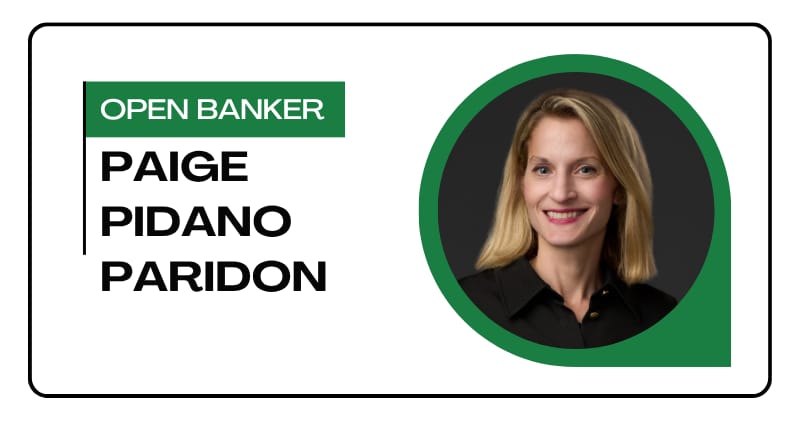
Paige Pidano Paridon is Executive Vice President and Co-Head of Regulatory Affairs at the Bank Policy Institute, where she leads consumer financial regulation advocacy alongside digital assets, payments and innovation regulatory policy. Before joining BPI, she was Managing Director and Senior Associate General Counsel at The Clearing House and prior to that Counsel in the Legal Division of the Board of Governors of the Federal Reserve System.
Open Banker curates and shares policy perspectives in the evolving landscape of financial services for free.
America has one of the most competitive banking systems in the world, home to more than 4,000 banks, 4,000 credit unions, and over 10,000 fintech companies. These entities underlie the safe, efficient payment system in the U.S. that allows consumers significant choice in how they pay. But you wouldn’t know it by listening to fintech lobbyists. They warn that the United States’ payment system will be less efficient — and more expensive — than its international counterparts if fintechs aren’t granted the benefits of banks, without any of the regulatory and supervisory costs. America’s banks welcome competition — so long as the competition is based on serving customers, rather than on regulatory arbitrage.
A Risky Solution to a Specious Problem
Fintechs have in recent years sought to obtain special “novel” bank charters that authorize them to do certain banking activities while subjecting them to just a fraction of the regulatory and supervisory framework that would apply to an ordinary bank. Their efforts have paid off, and several of these novel charters are now available.1
But these novel charters have been inadequate, according to fintech lobbyists. Key to juicing U.S. competitiveness, they allege, is allowing less regulated institutions to engage in even more banking activities — most critically, by having direct access to a Federal Reserve master account.
A Fed account will give these entities unfettered access to the nation’s payment rails and potentially parts of the federal safety net. Recent op-eds have proposed that modernizing the payments system requires opening up access to the Federal Reserve’s payment rails to uninsured fintechs and other less regulated entities. Even some legislators have taken up the issue.2
Skinny Accounts, Big Risks
Hearing these calls, the Federal Reserve recently asked for input on a limited “Payment Account” that would provide payments-focused fintechs access to some, but not all, of the Fed’s payments products and services. The Fed has sensibly designed the Payment Account with features that would limit the risks these novel entities could pose to the Reserve Banks, the payment system and other financial institutions, including (i) no interest on reserves, (ii) balance caps, and (iii) safeguards against credit risk.
But even the proposed limitations are not sufficient to protect against the risks these firms could present to the system. At a fundamental level, relaxing standards for obtaining limited Fed accounts — even with additional safeguards — could greatly expand access to Reserve Bank payment services by uninsured institutions. Institutions that facilitate payments tend to accumulate balances resembling deposits, and certain states offer charters that permit uninsured deposit-taking. By providing a more streamlined avenue for these institutions to obtain account access, these uninsured institutions may be able to increase their customer base and therefore hold more customer funds without deposit insurance. Deposit insurance exists for a reason: deposits (and deposit-like liabilities) are subject to run risk.
Fintechs Want it Both Ways
But, again, this limited account is not enough for the fintechs who want the full package offered almost exclusively to insured depository institutions and other lower-risk institutions subject to comprehensive federal supervision.3 For example, they want access to FedACH. The Fed, however, lacks an automated means of rejecting ACH transactions that could pose credit risk to the Federal Reserve Banks. Furthermore, complex payment systems like FedACH require participating depository institutions to have sufficient sophistication and expertise to manage the clearing and settlement of a high volume of ACH items. Allowing entities without this expertise — and not subject to federal prudential supervision — to access FedACH could result in increased risk to consumers and other financial institution customers if the fintechs originate unauthorized debits or improperly reverse ACH transactions. Other financial institutions might also be exposed to risk if the fintechs prove unable to settle their ACH transactions. In short, these fintech entities want to act like banks while avoiding the supervisory and regulatory framework that applies to actual banks. For these fintechs, the duties and responsibilities — and costs — that come along with a real bank license are simply too great. That asymmetry does not work for consumers or financial stability. If a fintech behaves like a bank, it should be supervised and regulated like one.
Finally, proponents of Fed-access-for-all-firms point to the success of other countries in expanding access to central banks for well-regulated payments firms. But these comparisons are inapt. Every country is unique in its financial system. Unlike nearly any other country in the world, the U.S. currently offers over 9,000 depository institutions access to central bank payment rails. In addition, the oversight of nonbanks granted access to central bank accounts differs across countries. For example, in the U.K., the Financial Conduct Authority is required to (i) authorize non-bank payment service providers to ensure they meet rigorous conduct and consumer protection standards before gaining eligibility for Bank of England settlement accounts and (ii) supervise these institutions for ongoing compliance with these standards. The Federal Reserve does not propose to hold fintechs to these standards, and if it did I expect few — if any — of them would be willing or able to meet them.
Lowering Standards Harms Consumers
Raising the alarm that the U.S. is losing ground to other countries is clearly designed to achieve fintechs’ ultimate aim: all the benefits of a full-service bank charter without all of the obligations or responsibilities — but it is disingenuous and not grounded in fact. Don’t buy the fintech sales pitch. Keep consumers safe by keeping banking for banks.
The opinions shared in this article are the author’s own and do not reflect the views of any organization they are affiliated with.
[1] For example, Wyoming offers a charter for “special purpose depository institutions,” or, “SPDIs,” which are “fully-reserved banks that receive deposits,” are “likely [to] focus on digital assets,” and “are not required to obtain insurance from the Federal Deposit Insurance Corporation.” https://wyomingbankingdivision.wyo.gov/banks-and-trust-companies/special-purpose-depository-institutions
[2] For example, during the last Congress, Rep. Ritchie Torres introduced the Affordable Remittances Act, which would provide "affordable remittance providers" access to FedNow bypassing the current process under which the Federal Reserve Banks have discretion to grant access to Federal Reserve accounts and services.
[3] For example, eligible institutions engaged in traditional trust activities would fall into this category.
Open Banker curates and shares policy perspectives in the evolving landscape of financial services for free.
If an idea matters, you’ll find it here. If you find an idea here, it matters.
Interested in contributing to Open Banker? Send us an email at [email protected].

OPEN BANKER SALON - JUNE 5, 2026
We started Open Banker to raise the quality of financial policy debate. Now, we are bringing the newsletter to life with our first ever event: Open Banker Salon. This isn't a typical conference. No 40-minute talking-head panels. No bland keynotes. The Salon is designed for real intellectual engagement with in-depth debate-style discussions.
Location: The Aspen Institute, Washington, DC
Subscriber-only pricing ends on April 10 (this Friday). Pay just $595, a 40% discount off the regular price. Register here today!